Regd. No. 131741/071/072 WhatsApp No. +977 9841073239 himalayadarshantreks@gmail.com
"Your Trusted Gateway to the Himalayas"
Per person - All price inclusive
Thorong Peak Climbing is one of the most popular and successful adventure programs for adventurers. Thorong Peak is located in the Annapurna Region and is a relatively easy climb. It is not true that prior trekking peak experience is required to climb Thorong Peak. However, you must be emotionally and physically prepared for this exciting adventure.
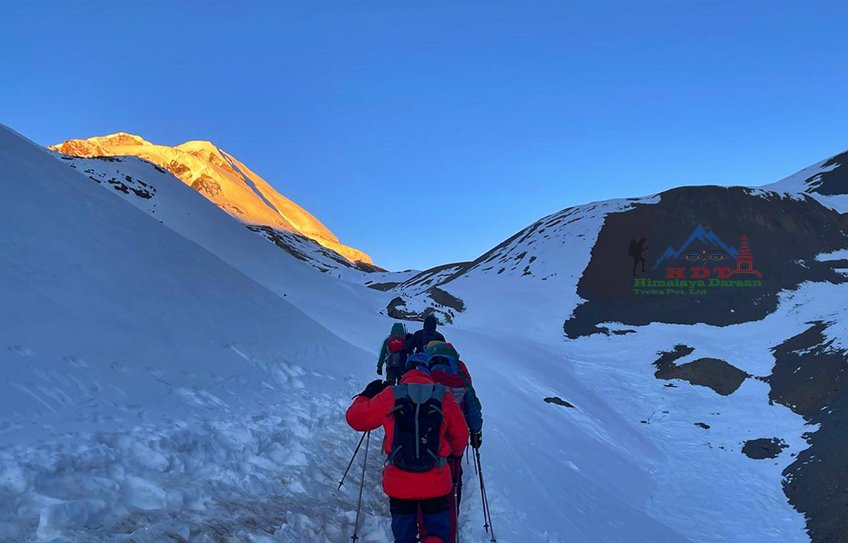
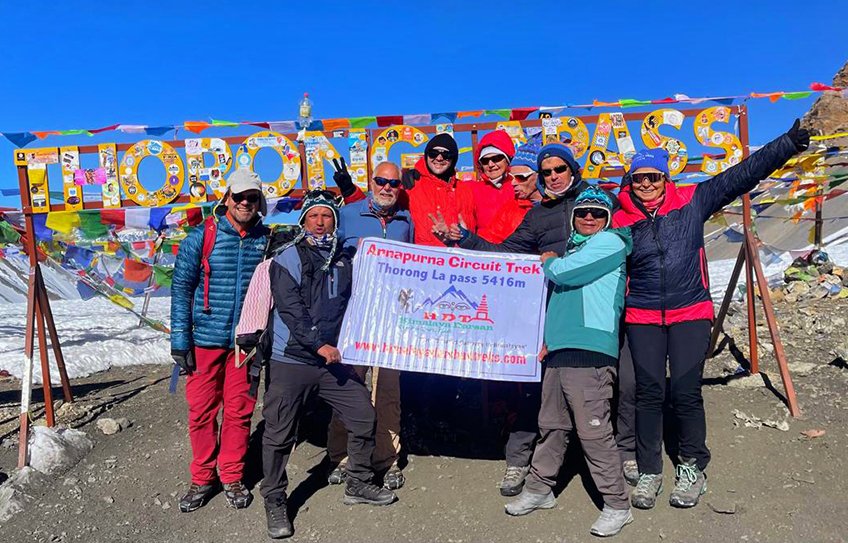
Thorong Peak is visible above on the approach to the well-known Thorong La Pass (5416 m). Thousands of hikers travel every year. Climbing the spectacular but challenging Thorong Peak requires a permit, a qualified climbing guide, and going through a registered trekking service in Nepal. Prior knowledge is indeed required to reach the summit.
For this adventurous ascent, you must be spiritually prepared as well as physically fit. This trek will take you to the most breathtaking mountain views, as well as delightful Gurung and other community hamlets with slate-covered buildings, where you can explore the excellent rhododendron (Nepal’s national flower) jungle, which will give you a variety of emotions.
Climbing to the top of Thorong Peak is a challenging job that requires physical strength, skill, and high mountain climbing experience. Here are some of the difficulties that climbers may encounter when climbing Mount Thorong:
Altitude:
One of the biggest challenges mountaineers face when climbing Mount Thorong is the altitude. The top of Thorong Peak is at 6,144 meters, which means that climbers will be exposed to high-altitude conditions for a long time. Thin air at high altitudes can cause altitude sickness, which can be life-threatening if left untreated. Climbers should take appropriate measures to acclimate to the altitude and avoid altitude sickness.
Technical terrain:
Climbing to the Thorong Peak Summit involves technical terrain, requiring skill and climbing experience. Climbers will encounter steep rock faces, icy slopes, and narrow ridges during the climb. The use of technical equipment such as ropes, harnesses, and hooks is essential for safe movement over difficult terrain.
Weather:
Weather conditions in the Annapurna Region can be unpredictable and severe. Climbing to Thorong Peak is best during the climbing season, which runs from April to May and October to November. Even during this time, climbers can experience heavy, windy snow and temperatures below zero degrees. Climbers have to prepare for all weather conditions and have the necessary equipment to deal with them.
Climbing Mount Thorong requires good physical fitness. Climbers must be able to walk several hours a day, often at high altitudes and over rough terrain. A good level of cardiovascular fitness, endurance, and strength is essential to completing the climb safely and successfully.
Location:
Climbing Mount Thorong is in a remote location, and climbers should prepare to be away from civilisation for a few days. For tented accommodation during the climb, we have to bring all necessary gear. The remoteness of the location also means that emergency medical assistance is difficult to access in the event of an emergency.
Despite the difficulty, climbing Mount Thorong is a rewarding experience that offers breathtaking Himalayan views and a chance to challenge yourself in a remote and beautiful part of the world.
The best time for climbing Thorong Peak is during the spring (March to May) and autumn (September to November) seasons. These periods offer stable weather, clear skies, and optimal climbing conditions, making the experience safer and more enjoyable.
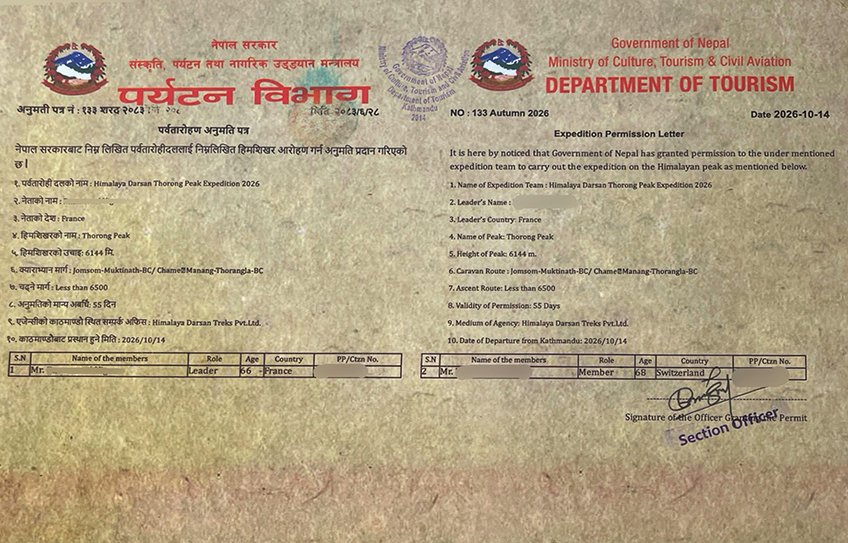
The permit fee depends on the mountaineering season. In the spring season, the permit fee is more expensive because it is the best mountaineering season. We need to issue a Thorong Peak Permit from the Tourism Board Department of Mountaineering. The permit fee structure is: –
Himalaya Darshan Treks highly recommends this Thorong Peak Climbing + Annapurna Circuit Trek. Especially, we provide our best-quality service with our very experienced and professional staff. Besides that, we offer many other peak climbing packages.
To book this trip or for more inquiries, click Book this trip on our web page. Likewise, we have many different trekking, tour, and Peak Climbing packages, so you can choose the most suitable trek with us. We suggest early booking so you have enough time to prepare for the trip. We are ready to organise your travel bucket list adventure in the Himalayas. You can also contact us by WhatsApp at +977 9841073239 for quick inquiries.
We at Himalaya Darshan Treks are highly recommended for good quality equipment for the successful and safe summit of Thorong Peak. The quality equipment makes your peak climbing comfortable and safe. Before the climb, our climbing Sherpa/guide checks your equipment and assists in how to use this equipment/climbing gear. We always give priority to your safety and the success of your climb, which means you are in safe hands.
1. Clothing:
2. Headwear:
3, Handwear
5. Footwear:
6. Personal Items
8. Drinks/Hydration:
Note: For the trekking equipment, you can check our Trekking Gear List on our website. If you have any confusion or questions, feel free to get in touch with us or email us at himalayadarshantreks@gmail.com.
We, Himalaya Darshan Treks, heartily welcome you and your group to Nepal. One of our company staff will take you to your hotel in Kathmandu. The person will be waiting outside the baggage hall of the Tribhuwan International Airport, Kathmandu, holding an A4-size paper with your name and our company name. So, you have to look for that person for your pickup from the airport.
We will begin our trips this morning after breakfast with a drive through the picturesque Nepalese countryside to Bhulbule (850 m). Afterward, we will again drive to Jagat (a small hill in the footsteps of Annapurna and Manaslu) by jeep (Full-board accommodation at a tea house)
After breakfast, we’ll take a one-and-a-half-hour rocky trail trek to Chamje hamlet, a small rural population surrounded by bamboo bushes with a primary school. Our adventure continues with a suspension bridge across the Marshyangdi River just after leaving Chamje.
You will view a waterfall, rocky hills, trails, and a little teashop before entering the Manang district soon before Tal village. This is a lovely community on the riverbank with a stunning waterfall view. You’ll cross the river and continue trekking through the cliffs above the river to Dharapani village, where we’ll spend the night. (On a full-board basis, spend the night at a tea house.)
Bagarchhap is about an hour’s walk from Dharapani. This lovely village may see the first glimpse of Mt. Annapurna II. On this day, you will pass through a few steep forested landscapes and multiple landslides; nonetheless, keep your eyes out for some spectacular views of prominent Himalayan peaks.
On your way to Chame on this day, you’ll pass through some traditional Tibetan villages (2670 m). Chame is Manang’s district headquarters and one of the most picturesque Himalayan settlements, with near views of Mt. Lamjung and Annapurna II. (Full-board accommodation at a tea house).
Another beautiful stroll through a narrow, steep trail that follows the riverbank will lead you to the settlement of Bratang, where you can stop for tea. After that, we followed the forested walk and rough trails for an hour before crossing the suspension bridge and arriving at Dhukur Pokhari for lunch.
This little village will see the first view of Pisang Peak and the surrounding Himalayan peaks. After lunch, we’ll walk for an hour to reach our next destination, Pisang hamlet. (Full-board accommodation at a tea house)
Today we travel through the drier upper route, which is shielded from the monsoon’s full force by the Annapurna Range. For a portion of the year, the people of this region herd yaks and grow vegetables.
The trail continues from Mungji to adjacent Manang, passing through the scenic but largely hidden settlement of Braga (3475 m).
In Manang, we spent the day acclimating. We spent the entire day doing beautiful day hikes and marveling at the breathtaking vistas around the village; daytime is the optimum time to gain altitude.
The charming community of roughly 500 flat-roofed dwellings is nestled amid some outstanding landscapes—Annapurna II, Annapurna III (7555 m), and Gangapurna (7454 m) to the south; Tilicho (7132 m) and the Grand Barrier to the west; and Chulu West (6583 m) and Chulu East (6059 m) to the north. We return to our lodging and retire for the night at the end of the day. (Full-board accommodation at a tea house).
After a magnificent exploration of Manang village this morning, we started for Yak Kharka, leaving the route to Tilicho Lake on the left corner and continuing a short hike up to Yak Kharka, a little community nestled at the base of the mountain (4110 m). We’ll climb gradually towards a small hill, then turn right behind it to reach Yak Kharka/Ledar (4,200 m), where we’ll spend the night. Remind yourself that you can hike up to a small hill for a beautiful view of the surrounding mountains. (Full-board accommodation at a tea house).
Another short day with views from above takes you to Thorong Phedi’s pass for lunch. A small yet bustling community that caters to the requirements of hikers and climbers. It is located at the base of the Thorong-La, and the trails continue to ascend to the top of the Thorong-La. We trek for an hour after lunch to reach a high camp (4800 m) for the night. (On a full board basis, spend the night at a tea house).
It takes 3-4 hours to trek from Thorong Phedi to Thorong Peak Base Camp. When you get to Thorong Peak base camp, you will have time to recover and prepare for the next day’s ascent. (Full-board accommodation in a tented camp).
In the early morning, we start to climb Thorong Peak Summit (6,144 m) and trek back to Muktinath (3,800 m). (Start to climb around 1:00 a.m., Thorong Peak Summit (6,144 m), then trek back to Thorong La top and continue trekking back to Muktinath.) Long and hard day. (Full-board accommodation at a tea house).
Today, we woke up to the beautiful sounds of temple bells and traveled to the Muktinath Temple region, a well-known pilgrimage location. After breakfast, it’s a short walk down to Kagbeni. To Kagbeni, the trail drops through a stunning, arid environment. Kagbeni can be reached only by crossing the Kaligandaki River on both sides.
Perhaps you’ll have lunch in Kagbeni. After a few hours of walking from Kagbeni, we arrived in Jomsom, a large town and the administrative center of Mustang district. It has an airfield above the Kaligandaki River and is a critical settlement in the Kaligandaki area, connecting to Tibet via the ancient Trans-Himalayan Salt Trade route.
Today we will be taking a picturesque alpine trip to Pokhara, so we must gather our belongings and prepare. The aircraft passes between two high peaks, Mt. Annapurna (8091 m) and Mt. Dhaulagiri (8167 m), giving us the best views. We have a whole day in Pokhara to appreciate the natural beauty.
Visit the city’s highlights and the surrounding areas on a sightseeing tour of Pokhara Valley, like Fewa Lake, Tal Barahi Temple, etc. (On a BB basis, one night at a deluxe hotel).
Returning to Kathmandu entails a 7-hour trip through the Trisuli River and via numerous towns. You can spend your time relaxing or shopping for souvenirs to take home. In the evening, we will offer a goodbye dinner with cultural dance performances in a traditional restaurant to commemorate your incredible journey.
Today is the last day of this vacation in Nepal; you are saying your goodbyes to the mountains as your tour in Nepal comes to a close today.
But exchange emails with your travel partners and organize your images. You can go shopping or sightseeing if you have extra time. Himalaya Darshan Treks will pick you up from your hotel around 3 hours before your planned flight.

Yala Peak Climbing—A Beginner-Friendly Mountain Adventure with Himalaya Darshan Treks. The Yala...

Ama Dablam, also known as Amai Dablang, popularly known as the 'Matterhorn...

"Lobuche Peak Climbing—Conquer the Himalayas, Embrace the Everest Spirit with Himalaya Darshan...

Pisang Peak, at 6,091 meters, is one of Nepal's most beautiful summits....